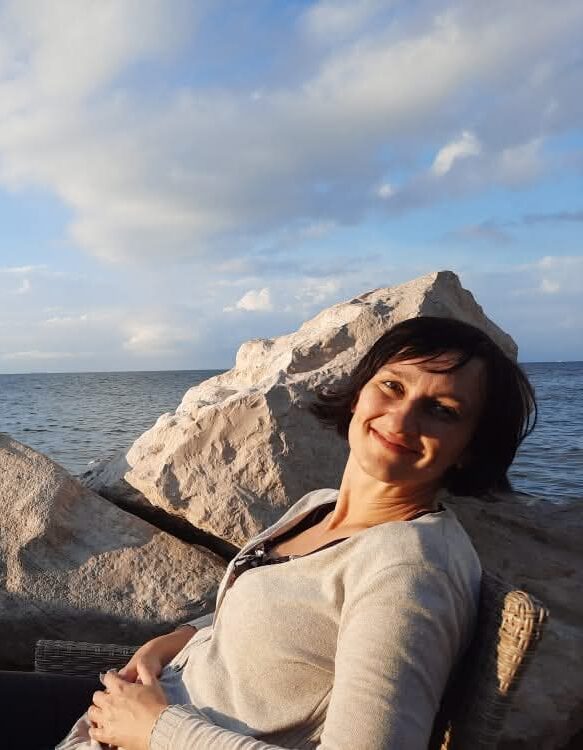
Today in the spotlight: MATEJA SOFTIĆ, Co-founder and Co-creator, Iskriva Institute.
Mateja in three words:
Curious, creative, sparkling.
Why is co-creating Iskriva’s Institute stories your dream job?
Because, on the one hand, it gives me a great deal of freedom and space for creativity, while at the same time, each project brings new and increasingly demanding challenges that foster both personal and professional growth. In the end, the greatest satisfaction comes when the right idea at the right time, with the right people, leads to concrete and tangible results that improve the quality of life and work in the local environments where we operate.
You are at the heart of numerous projects that push boundaries both in Slovenia and across the Danube region and beyond, including the renovation of the Old Ironworks in Ravne na Koroškem. What is currently happening in Ravne, and what will be the long-term impact of the Old Ironworks renovation on the local environment and beyond?
We have entered the fifth year of our collaboration with Ravne na Koroškem on the revitalization of the Old Ironworks. With the opening of the first two renovated buildings last year, the real work is only now beginning—namely, how to ensure the stable implementation and financing of programme content. Together with our local and international partners, we are currently focusing on establishing a high-quality programme. Plans include the first festival of culture, art, and science, as well as hosting a range of international events, summer schools, training sessions, and workshops. We will continue to guide the development of this space toward activities that position it not only as an internationally connected hub for development, culture, and research, but also as a generator of income for the local community.
This year, you are dedicating a great deal of attention to the Danube Dance Alliance project, which connects dance, architecture, and community engagement to bring dance closer to audiences across the Danube region. How does this project fit into the broader context of Iskriva’s work?
The project connects our New European Bauhaus on the Danube network, which promotes green investments in the revitalization of degraded areas, with the Balkan Dance Project platform, which brings together independent contemporary dancers and choreographers from the Balkans. This interdisciplinary project links dance, theatre, architecture, cultural heritage, development, and cultural tourism with the aim of creating a dance co-production that will revive abandoned or somewhat forgotten spaces in Slovenia, Croatia, Serbia, and Bosnia and Herzegovina—both through live performances and as a VR experience. At the same time, it brings dance to places where audiences would not normally have the opportunity to experience high-quality international performances.
Through this approach, we emphasize the role of culture as a driver of more responsible spatial use, while also creating opportunities for work and artistic creation for artists across the Danube region, as well as new connections for their further collaboration and the development of contemporary dance in the area.
As part of your work as a consultant, you also collaborate with the European Commission. Why is international engagement important for Slovenia and its visibility, and what does it mean to you to share your knowledge and experience at the European level?
European strategies are often difficult to translate into concrete measures on the ground, as there is a gap between theory and practice—what is actually feasible in a given context with available resources, and how. It is therefore essential to bring real-world experience into dialogue with the European Commission. In particular, we strive to ensure an understanding that meaningful change takes time, and that measures can only be implemented by taking into account local specificities and the capacity to manage development processes.
In this way, we share our field experience with the European Commission to support the development of more realistic and implementable measures aligned with actual local needs.
Which book or podcast have you recently read or listened to and would recommend to everyone?
I enjoy listening to conversations with different creators about the creative process, what motivates them, and how artists approach their work. Since dance is in the spotlight this year, I recommend the conversation with dance artist Mojca Majcen in the show Profil.
In this spirit, I would also recommend the autobiography by Booker Prize-winning author Bernardine Evaristo, Manifesto: On Never Giving Up.